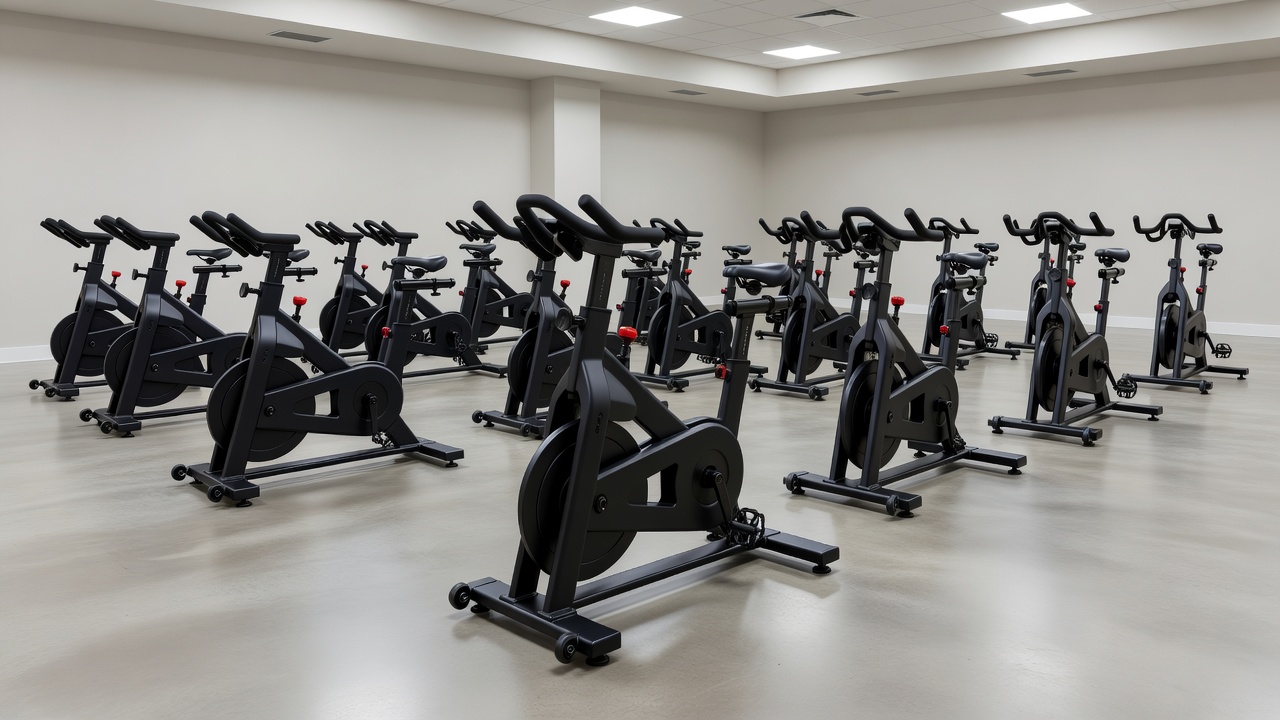
Plan around sessions, not a shopping list
A room used for supervised rehabilitation has different demands from a team interval session or an individual physiological assessment. Before comparing trainers, describe who will use the space, what staff need to observe and how riders arrive and leave. A layout that looks spacious when empty can become awkward once bicycles, bags, towels and moving people are added.
For riders, this means asking what your booking actually includes. Will someone set up the bicycle, supervise the effort and help interpret the session? Is the room shared, and can a demanding test take place without interruption? For planners, it means testing a realistic operating scenario before fixing the room layout or purchasing the full equipment set.
Check the complete equipment chain
A direct-drive trainer needs compatibility with the rider’s axle, drivetrain and bicycle. A dedicated indoor cycle needs an adjustment range appropriate to the intended users. Pedals, crank options and accessible transfer arrangements may matter more than a long software feature list. Confirm these details before a visit rather than assuming that bringing your own bicycle solves every compatibility issue.
Equipment documentation from manufacturers such as Wattbike and SRM helps establish model-specific capabilities. It does not guarantee agreement between different devices. If training targets originate on one power meter and are applied on another, staff should acknowledge possible offsets and avoid treating every displayed watt as perfectly interchangeable.
Give heat and airflow their own plan
Indoor riding reduces the natural airflow available outdoors. A rider may therefore experience a familiar workload very differently without adequate cooling. Fans can improve local air movement, while ventilation manages the room’s air exchange. They are related but distinct functions, and a fan does not by itself demonstrate that a room is suitably ventilated.
Room occupancy, heat from equipment, humidity and session duration all influence conditions. Staff should know how the environment is managed and when it needs adjustment. The Health and Safety Executive’s ventilation guidance is a useful operational reference in the United Kingdom. It is not a universal prescription for a particular cycling room, which still needs assessment for its actual use.
Make access part of the core layout
A useful room supports safe arrival, changing, bicycle handling and movement between services. Riders with mobility, sensory or other access requirements should be able to ask about practical arrangements before booking. Avoid reducing accessibility to a single doorway measurement. The route from the entrance, toilet provision, transfer assistance and communication format can all affect whether the service is usable.
Sport England publishes facility-planning resources that can inform broader thinking. Different settings have different legal and operational requirements, so specialist design advice may be necessary. For a rider, the important question is concrete: can the centre explain how your visit will work, including any limitations, without asking you to discover barriers on arrival?
Support observation and safe intervention
Staff need a clear view of riders and a practical way to communicate over fans and equipment noise. Screens should be readable without forcing an unsuitable riding posture. Cables, power supplies and loose equipment should not intrude into circulation routes. Emergency stopping procedures need to be understood by both the practitioner and the rider, particularly during strenuous assessments.
Supervision is a service characteristic, not something to infer from the building’s professional appearance. Ask who is present, what their role is and how help is summoned. A centre should also distinguish between a coached session, an independently booked workstation and a clinical service. These arrangements carry different expectations and should not be blurred by general performance language.
Keep the room repeatable between riders
Changeover time is part of capacity. Staff need a process for cleaning contact surfaces, resetting adjustments, checking equipment and removing the previous rider’s data from shared displays. A room that can technically hold many bicycles may still have limited practical throughput if every visit requires detailed setup or a private discussion.
Record the settings that matter for repeat sessions: bicycle coordinates, pedal arrangement, device identity and relevant environmental conditions. Store maintenance and fault reports where the right staff can act on them. The best training space is not necessarily the largest or most technologically elaborate. It is one in which riders can execute the intended work, staff can interpret what happened and the next session can begin from a known starting point.
Actual session conditions, equipment used, completion notes, comfort feedback and any interruptions or technical faults.